Organizations invest significantly in developing the skills of their IT teams. New methodologies, AI-powered tools, automation frameworks, and best practices require continuous learning to stay competitive.
Yet many organizations experience the same frustration.
The training receives positive feedback. Participants enjoy the sessions, gain new insights, and leave inspired. But a few months later, little has changed in the day-to-day way of working.
The question isn’t whether the training was successful.
The real question is:
Why doesn’t learning automatically lead to better performance?
Knowledge is only the first step
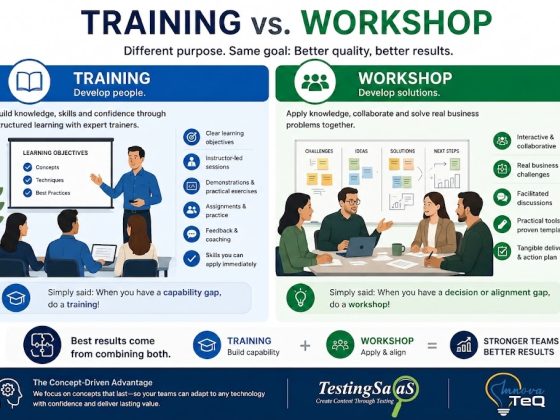
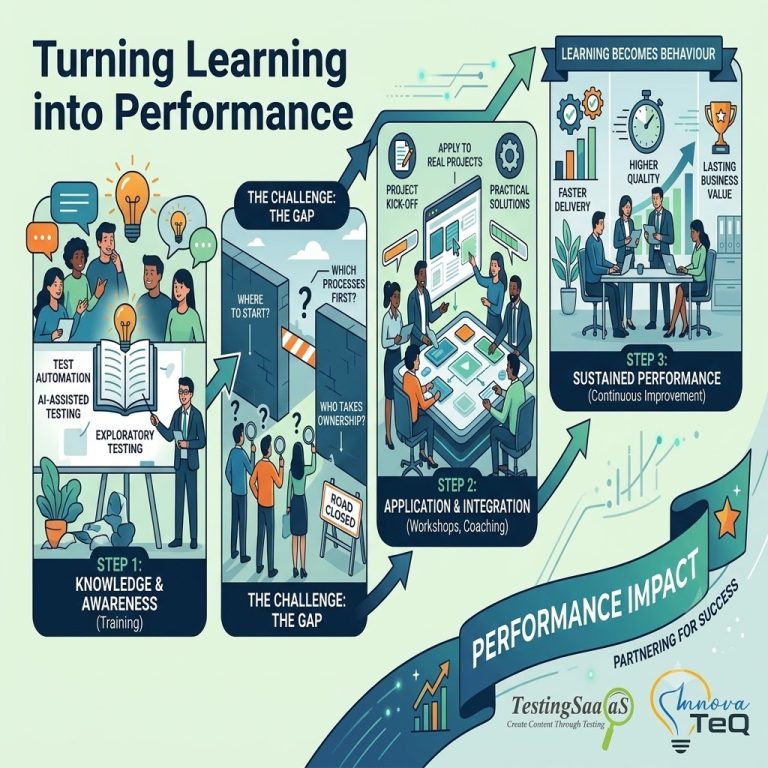
Training creates awareness and builds knowledge. It introduces new concepts, techniques, and best practices. This foundation is essential, but knowledge alone rarely changes behaviour.
Returning to the workplace often means stepping back into familiar routines. Tight deadlines, ongoing projects, and established processes make it difficult to experiment with newly acquired skills.
Without opportunities to apply what has been learned, even the best training starts to fade.
The gap between learning and doing
One of the biggest challenges organizations face is translating theory into practice.
Consider a team that has completed training on test automation, exploratory testing, or AI-assisted testing. Everyone understands the concepts, but questions quickly arise:
- Where do we start?
- Which processes should we adapt first?
- How do these new practices fit within our current way of working?
- Who takes ownership?
These are not training questions.
They are implementation questions.
Performance changes through application
Real improvement happens when teams apply new knowledge to their own environment.
This is where workshops play an important role. Rather than focusing on theory, workshops enable teams to work on real challenges together. They discuss current processes, identify bottlenecks, and develop practical solutions that can be implemented immediately.
Learning becomes part of daily work instead of remaining a one-time event.
Continuous learning creates lasting results
High-performing quality engineering teams don’t view learning as a single activity.
They see it as an ongoing process of learning, experimenting, receiving feedback, and improving.
This may include:
- Follow-up workshops after a training
- Coaching on real projects
- Knowledge-sharing sessions within the team
- Practical assignments between learning sessions
- Regular reflection on progress and outcomes
These activities reinforce learning and make behavioural change sustainable.
A combined approach delivers greater impact
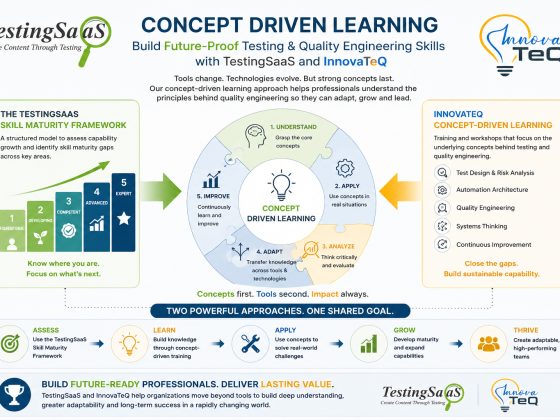
At TestingSaaS, together with our partner InnovaTeQ, we believe that lasting performance improvement requires more than delivering knowledge.
Our approach combines expert-led training with collaborative workshops, allowing teams to immediately apply new skills to their own projects, processes, and challenges.
This not only increases confidence but also accelerates adoption and creates measurable business value.
Because the real return on investment isn’t measured by the number of certificates earned.
It’s measured by stronger collaboration, higher software quality, faster delivery, and teams that continuously improve.
Your take away
Training remains one of the most valuable investments an organization can make.
But training is only the beginning.
When learning is followed by application, coaching, and continuous improvement, knowledge evolves into behaviour, behaviour drives performance, and performance creates lasting business impact.
How does your organization ensure that learning turns into measurable improvements?
We’d love to hear your experience.