
Monthly Archives :

juli 2026

walking up the stairs for illustrating a learning journey

The Learning Journey of High-Performing Quality Engineering Teams

The Learning Journey of High-Performing Quality Engineering Teams 1024 1024 Cordny

Why Building Capability Is a Journey, Not a One-Time Event

Organizations invest heavily in training their Quality Engineering teams. Teams attend courses on test automation, AI-assisted testing, observability, performance engineering, and agile quality practices. Yet many organizations struggle to translate this investment into lasting improvements.

The reason is simple.

Capability doesn’t develop overnight. It matures over time.

High-performing Quality Engineering teams don’t become successful because they attended a single training course. They continuously learn, experiment, collaborate, and improve. Their success is the result of a deliberate learning journey.

At TestingSaaS, together with our partner InnovaTeQ, we believe that sustainable improvement comes from guiding teams through a maturity journey rather than delivering isolated training sessions.

Many organizations approach learning as a collection of individual events.

A Maturity Model Instead of a Training Calendar

  • A Playwright course this month.
  • An AI webinar next month.
  • A performance workshop later in the year.

While each activity may be valuable, they often lack a common direction.

A maturity model provides that direction by answering one important question:

Where are we today, and what is the logical next step?

Instead of focusing on isolated skills, a maturity model focuses on developing organizational capability over time.

The Learning Journey

We view capability development as six progressive stages.

Awareness
      ↓
Training
      ↓
Practice
      ↓
Workshop
      ↓
Coaching
      ↓
Continuous Improvement
      ↓
Business Value

Each stage builds upon the previous one.

Stage 1 – Awareness

Every improvement starts with awareness.

Teams first need to understand why change is necessary.

Questions often include:

  • Why should we improve our testing approach?
  • What is observability?
  • How can AI support Quality Engineering?
  • Why is performance engineering becoming more important?
  • What challenges are slowing our delivery?

At this stage, organizations are creating curiosity rather than changing behaviour.

Typical activities include:

  • Conference talks
  • Lunch-and-learn sessions
  • Webinars
  • Internal presentations

The goal is to inspire.

Stage 2 – Training

Once awareness exists, teams need knowledge.

Training builds capability by introducing concepts, frameworks, and practical techniques.

Examples include:

  • Observability Strategy Training
  • Application Performance Training
  • AI-assisted Testing
  • Test Automation with Playwright
  • Exploratory Testing

Participants develop new skills and gain confidence.

But knowledge alone rarely changes the way teams work.

Stage 3 – Practice

Learning only becomes valuable when it is applied.

This stage focuses on experimentation.

Teams begin using their new skills in a safe environment.

Typical activities include:

  • Pilot projects
  • Practical assignments
  • Pair testing
  • Internal hackathons
  • Automation spikes

Mistakes are expected.

Experimentation is encouraged.

Learning accelerates through experience.

Stage 4 – Workshops

After initial practice, teams often encounter organizational challenges rather than technical ones.

Questions shift from:

“How does this work?”

to

“How do we make this work here?”

This is where workshops become essential.

Instead of teaching theory, workshops help teams:

  • Align stakeholders
  • Improve collaboration
  • Design processes
  • Prioritize improvements
  • Build implementation roadmaps

Knowledge becomes organizational change.

Stage 5 – Coaching

Real transformation takes time.

Coaching helps teams overcome the challenges that inevitably arise after implementation begins.

Rather than providing answers, coaches help teams:

  • Reflect on progress
  • Solve real-world problems
  • Remove obstacles
  • Improve collaboration
  • Strengthen decision-making

Coaching creates confidence.

Confidence creates consistency.

Stage 6 – Continuous Improvement

High-performing teams never stop learning.

Continuous improvement becomes part of everyday work.

Characteristics include:

  • Regular retrospectives
  • Knowledge-sharing sessions
  • Continuous experimentation
  • Performance measurement
  • Cross-team collaboration
  • Communities of Practice

Learning is no longer an event.

It becomes part of the organization’s culture.

The Result: Business Value

The ultimate goal isn’t more training.

It’s better business outcomes.

Organizations that continuously develop their Quality Engineering capability often experience:

  • Higher software quality
  • Faster release cycles
  • Earlier defect detection
  • Greater test automation effectiveness
  • Better observability
  • Improved collaboration
  • Increased customer satisfaction
  • Reduced delivery risk

Learning becomes measurable business value.

Why Concept-Driven Learning Matters

Technology evolves rapidly.

Today’s popular testing framework may be replaced in a few years.

The underlying concepts, however, remain relevant.

At TestingSaaS and InnovaTeQ, we focus on concept-driven learning.

By understanding principles such as testability, observability, maintainability, systems thinking, and risk-based testing, professionals can adapt confidently to new tools and technologies throughout their careers.

This creates future-proof Quality Engineering teams.

Assess Your Team’s Learning Journey

Ask yourself the following questions:

  • Are we only providing training, or are we supporting implementation?
  • Do our teams have opportunities to practise new skills?
  • Are workshops helping us solve organizational challenges?
  • Do we provide coaching after learning events?
  • Is continuous improvement embedded in our culture?
  • Can we measure the business impact of learning?

If the answer to several of these questions is “no,” your organization may be leaving significant value on the table.

The TestingSaaS Learning Journey

At TestingSaaS, in partnership with InnovaTeQ, we believe capability development is not a destination but a continuous journey.

Our approach combines:

  • Awareness through thought leadership and knowledge sharing.
  • Training to build technical and strategic capabilities.
  • Practice through hands-on assignments and pilots.
  • Workshops to solve real organizational challenges.
  • Coaching to support sustainable adoption.
  • Continuous improvement through reflection, measurement, and optimization.

Together, these stages help organizations move beyond learning and create lasting performance improvements.

Your Takeaway

High-performing Quality Engineering teams are not built through a single course or certification.

They are built through a structured learning journey that combines education, application, collaboration, coaching, and continuous improvement.

The organizations that invest in this journey don’t just develop better engineers—they build teams that adapt faster, innovate more confidently, and consistently deliver higher-quality software.

Learning creates capability.

Capability enables performance.

Performance delivers lasting business value.
Why Training Alone Doesn’t Change Performance

Why Training Alone Doesn’t Change Performance 1024 1024 Cordny

Organizations invest significantly in developing the skills of their IT teams. New methodologies, AI-powered tools, automation frameworks, and best practices require continuous learning to stay competitive.

Yet many organizations experience the same frustration.

The training receives positive feedback. Participants enjoy the sessions, gain new insights, and leave inspired. But a few months later, little has changed in the day-to-day way of working.

The question isn’t whether the training was successful.

The real question is:

Why doesn’t learning automatically lead to better performance?

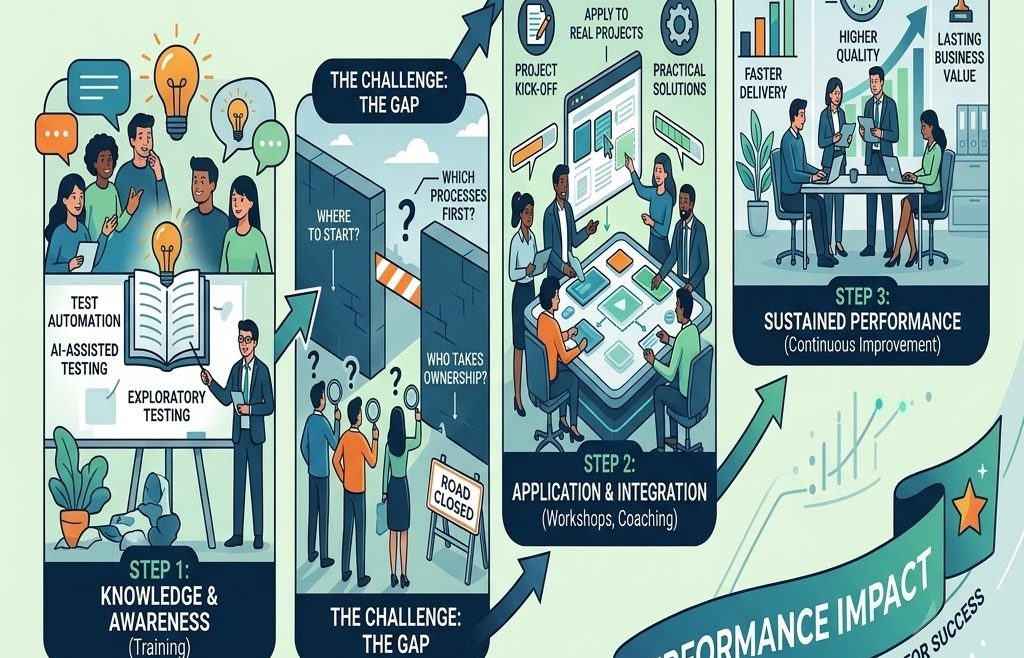
Knowledge is only the first step

Training creates awareness and builds knowledge. It introduces new concepts, techniques, and best practices. This foundation is essential, but knowledge alone rarely changes behaviour.

Returning to the workplace often means stepping back into familiar routines. Tight deadlines, ongoing projects, and established processes make it difficult to experiment with newly acquired skills.

Without opportunities to apply what has been learned, even the best training starts to fade.

The gap between learning and doing

One of the biggest challenges organizations face is translating theory into practice.

Consider a team that has completed training on test automation, exploratory testing, or AI-assisted testing. Everyone understands the concepts, but questions quickly arise:

  • Where do we start?
  • Which processes should we adapt first?
  • How do these new practices fit within our current way of working?
  • Who takes ownership?

These are not training questions.

They are implementation questions.

Performance changes through application

Real improvement happens when teams apply new knowledge to their own environment.

This is where workshops play an important role. Rather than focusing on theory, workshops enable teams to work on real challenges together. They discuss current processes, identify bottlenecks, and develop practical solutions that can be implemented immediately.

Learning becomes part of daily work instead of remaining a one-time event.

Continuous learning creates lasting results

High-performing quality engineering teams don’t view learning as a single activity.

They see it as an ongoing process of learning, experimenting, receiving feedback, and improving.

This may include:

  • Follow-up workshops after a training
  • Coaching on real projects
  • Knowledge-sharing sessions within the team
  • Practical assignments between learning sessions
  • Regular reflection on progress and outcomes

These activities reinforce learning and make behavioural change sustainable.

A combined approach delivers greater impact

At TestingSaaS, together with our partner InnovaTeQ, we believe that lasting performance improvement requires more than delivering knowledge.

Our approach combines expert-led training with collaborative workshops, allowing teams to immediately apply new skills to their own projects, processes, and challenges.

This not only increases confidence but also accelerates adoption and creates measurable business value.

Because the real return on investment isn’t measured by the number of certificates earned.

It’s measured by stronger collaboration, higher software quality, faster delivery, and teams that continuously improve.

Your take away

Training remains one of the most valuable investments an organization can make.

But training is only the beginning.

When learning is followed by application, coaching, and continuous improvement, knowledge evolves into behaviour, behaviour drives performance, and performance creates lasting business impact.

How does your organization ensure that learning turns into measurable improvements?

We’d love to hear your experience.

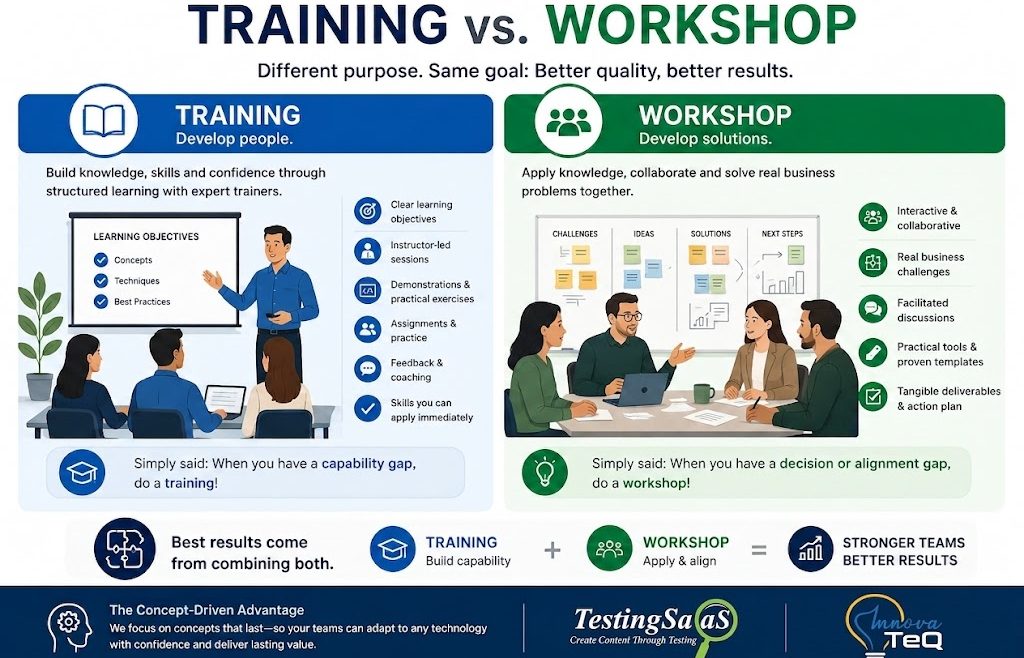
"Training vs workshop comparison for software testing and quality engineering teams."

Training vs. Workshop: Which One Does Your Team Really Need?

Training vs. Workshop: Which One Does Your Team Really Need? 1024 683 Cordny

Organizations invest thousands of euros each year in developing their software testing and quality engineering teams. Yet many still ask the same question:

Should we book a training or a workshop?

Although the terms are often used interchangeably, they serve very different purposes. Understanding the difference can help organizations choose the right approach and achieve far better results.

At TestingSaaS, together with our partner InnovaTeQ, we believe that learning and application should go hand in hand. That’s why many of our engagements combine expert-led training with collaborative workshops that turn knowledge into action.

What is a Training?

A training is designed to build knowledge, skills, and confidence. Participants learn new concepts, frameworks, techniques, and tools from experienced trainers in a structured environment.

The objective is simple: develop people.

A typical training includes clear learning objectives, instructor-led sessions, demonstrations, practical exercises, individual or small-group assignments, feedback, coaching, and hands-on practice. Participants leave with new skills they can immediately apply in their daily work.

Simply put: when you have a capability gap, choose a training.

Example: InnovaTeQ Observability Strategy Training

The Observability Strategy Training is a strategic, decision-level training that goes beyond tools and dashboards. It helps architects and technical leaders assess their organization’s observability maturity and define a clear, organization-wide observability strategy.

Participants learn to build the practical, system-level skills needed to translate telemetry, maturity insights, and cross-team collaboration into a sustainable observability strategy. By the end of the training, they understand why certain practices work and have developed a shared strategic vision, not just learned how to use a specific tool.

CLICK HERE -> InnovaTeQ Observability Strategy Training

Example: Application Performance Training for Agile Teams

This training helps agile teams build a shared performance mindset and reduce delivery risks by embedding performance thinking into everyday planning and implementation.

Participants learn how to validate whether application performance goals have been achieved, identify performance risks early, and define concrete improvement actions for upcoming sprints.

CLICK HERE -> InnovaTeQ Application Performance Training for Agile Teams

What is a Workshop?

A workshop serves a different purpose.

Rather than teaching new material, a workshop helps participants apply existing knowledge to solve real business challenges.

The objective is simple: develop solutions.

Unlike traditional training courses, workshops are not fixed modules. They are built from a collection of professional domains and adapted to the specific challenges of each organization. In practice, most workshops naturally revolve around a number of recurring themes while remaining highly interactive and collaborative.

A facilitator guides discussions, exercises, and decision-making, ensuring participants actively contribute throughout the session.

Instead of leaving with new knowledge alone, participants leave with tangible deliverables that their organization can immediately put into practice.

Simply put: when you have a decision gap or an alignment gap, choose a workshop.

Example: Performance Engineering and System Behavior Workshop

In this workshop, participants work together to:

  • Define realistic performance expectations.
  • Design workloads that reflect real-world usage.
  • Identify architectural risks at an early stage.
  • Apply proven templates tailored to their own systems.

Rather than leaving with a certificate, participants leave with a practical strategy and concrete next steps customized for their organization.

Other workshop themes include:

  • Operations and Reliability
  • Dynatrace Deep Dives
  • Custom performance engineering sessions
  • Organization-specific architecture workshops

CLICK HERE -> The InnovaTeQ Workshops

The Concept-Driven Advantage

Many training providers focus primarily on tools.

At TestingSaaS and InnovaTeQ, we focus on concepts first.

Technologies evolve rapidly. Today it may be Playwright; tomorrow it could be an entirely new platform. However, concepts such as abstraction, maintainability, observability, testability, systems thinking, and risk analysis remain valuable regardless of the technology landscape.

Professionals who understand these underlying concepts are better equipped to adapt to new tools, frameworks, and methodologies with confidence.

This philosophy forms the foundation of InnovaTeQ’s concept-driven learning approach.

Which One Do You Need?

Choose a training when your goal is to:

  • Build new skills.
  • Learn a new technology.
  • Upskill your team.
  • Establish a common knowledge foundation.

Choose a workshop when your goal is to:

  • Solve a business challenge.
  • Align stakeholders.
  • Design or validate a strategy.
  • Improve an existing process.
  • Produce a roadmap or action plan.

In many situations, the most effective solution is a combination of both. A training builds capability, while a workshop turns that capability into organizational results.

Ready to Build Future-Proof Quality Teams?

TestingSaaS and InnovaTeQ help organizations strengthen their software quality capabilities through concept-driven learning, practical workshops, and measurable capability development.

Whether you’re introducing AI into your testing process, modernizing your automation strategy, improving observability, or building a long-term quality engineering roadmap, combining the right training with the right workshop enables your teams to learn faster, align more effectively, and deliver greater business value.

Learn the concepts.

Apply them together.

Deliver lasting results.