In the world of software testing and quality engineering, new tools, frameworks, and methodologies emerge at a rapid pace. Teams often rush to learn the latest automation framework, AI-powered testing tool, or DevOps practice, only to discover that the knowledge becomes outdated within a few years. My education partner, InnovaTeQ, believes there is a better way: a concept-driven learning approach.
The concept-driven approach of InnovaTeQ
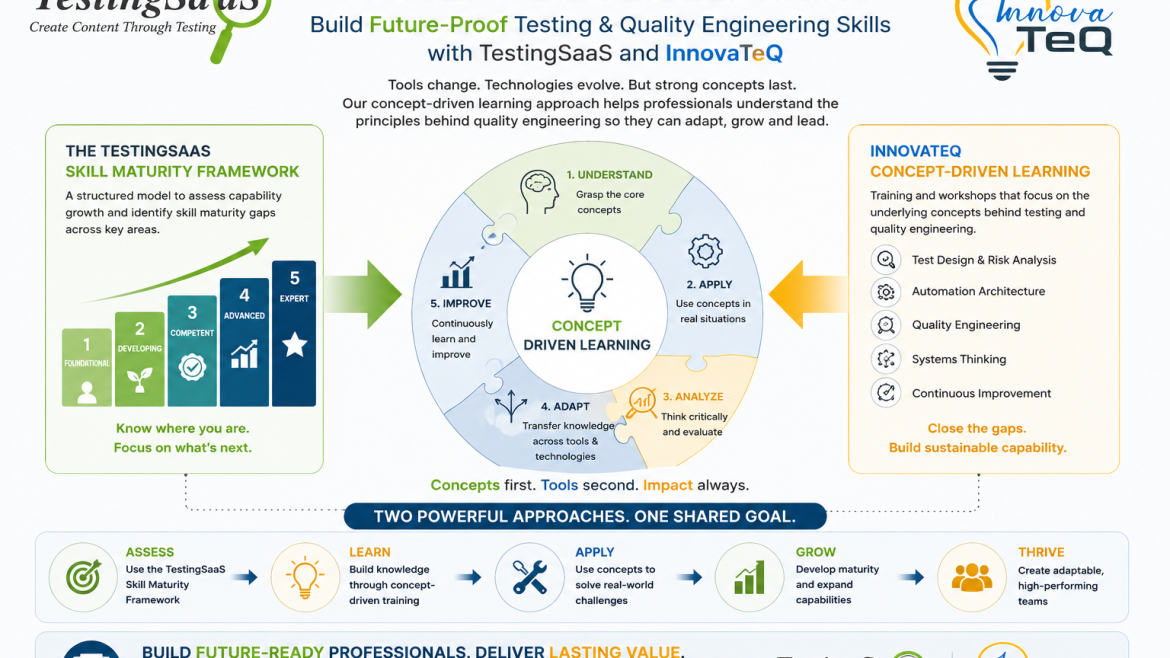
Rather than focusing solely on tools and technologies, InnovaTeQ’s training programs and workshops emphasize the underlying concepts that remain relevant regardless of which tool is popular today. Concepts such as test design, risk analysis, automation architecture, quality engineering, systems thinking, and continuous improvement form the foundation of sustainable professional growth.
The reason is simple. Tools change. Concepts endure.
When learners understand the principles behind a technology, they can adapt more easily when that technology evolves. A tester who understands the concept of automated regression testing can transition from Selenium to Playwright, Cypress, or future frameworks with much less effort than someone who has only memorized tool-specific commands.
This philosophy aligns closely with the TestingSaaS Skill Maturity Framework.
The concept-driven approach of TestingSaaS
The TestingSaaS Skill Maturity framework provides a structured model for assessing capability growth across multiple skill areas. It defines maturity levels and identifies what professionals can do at each stage of development. However, skill maturity is not achieved by collecting certifications or attending isolated training sessions. True maturity develops when individuals understand the concepts that underpin their daily work.
For example, a practitioner may learn how to create automated tests in a specific tool. That knowledge may help them achieve short-term results. However, reaching higher maturity levels requires a deeper understanding of concepts such as maintainability, abstraction, scalability, test strategy, and integration within CI/CD pipelines.
This is where the relationship between InnovaTeQ’s approach and the TestingSaaS framework becomes particularly powerful.
The TestingSaaS framework helps organizations answer the question:
“Where are our current skill maturity gaps?”
The InnovaTeQ concept-driven approach helps answer the next question:
“How do we close those gaps in a sustainable way?”
Instead of teaching learners to follow predefined steps, InnovaTeQ encourages critical thinking, exploration, and application of core principles. This enables professionals to develop capabilities that transfer across projects, industries, and technologies.
For organizations, this means training investments produce longer-lasting value. Teams become more adaptable, more resilient to technological change, and better equipped to solve complex quality challenges. For individuals, it creates a clearer path from foundational knowledge to advanced expertise.
In a rapidly changing software landscape, organizations need more than tool proficiency. They need professionals who understand the concepts behind quality engineering and can apply those concepts in new situations.
TestingSaaS and InnovaTeQ combined:
a winning learning concept
The combination of the TestingSaaS Skill Maturity Framework and InnovaTeQ’s concept-driven learning philosophy provides exactly that: a practical way to identify capability gaps and a sustainable method for developing the skills needed to close them.
By focusing on concepts first and tools second, organizations can build the kind of expertise that remains valuable long after today’s technologies have been replaced by tomorrow’s innovations.