Monthly Archives :

april 2026

How the TestingSaaS Skill Maturity Framework help you fill the skill gaps of your DevOps team

How the TestingSaaS Skill Maturity Framework Helps You Identify and Close Critical Skill Gaps

How the TestingSaaS Skill Maturity Framework Helps You Identify and Close Critical Skill Gaps 1536 1024 Cordny

In modern SaaS environments, quality is no longer just about testing, it’s about how capable are we across the entire delivery lifecycle.

Yet many teams still struggle with a fundamental question:

“Where do we actually stand in terms of skill maturity?”

The TestingSaaS Skill Maturity Framework was designed to answer exactly that, and more importantly, to expose the gaps that are holding teams back.

The Challenge: You Can’t Fix What You Can’t See

Most organizations operate with limited visibility into their true capabilities.

You might hear things like:

  • “We’re doing automation”
  • “We’ve implemented CI/CD”
  • “Our testing is solid”

But when you look closer:

  • Automation is brittle and hard to scale
  • CI/CD lacks meaningful quality gates
  • Testing is reactive instead of strategic

The issue isn’t effort, no, it’s lack of a structured maturity model.

What Is the TestingSaaS Skill Maturity Framework?

The TestingSaaS Skil Maturity Framework provides a practical, real-world model for evaluating skills across modern testing and quality engineering domains (and also other!)

It breaks down capability into:

  • Core skill areas (e.g., automation, exploratory testing, CI/CD, test strategy)
  • Clear maturity levels (from foundational to expert)
  • Observable behaviors that define each level

This allows teams to move from vague assumptions to objective, evidence-based evaluation.

How TestingSaaS Reveals Skill Maturity Gaps

1. It Defines What “Mature” Actually Looks Like

Instead of generic titles like junior or senior, TestingSaaS describes what people actually do at each level.

For example:

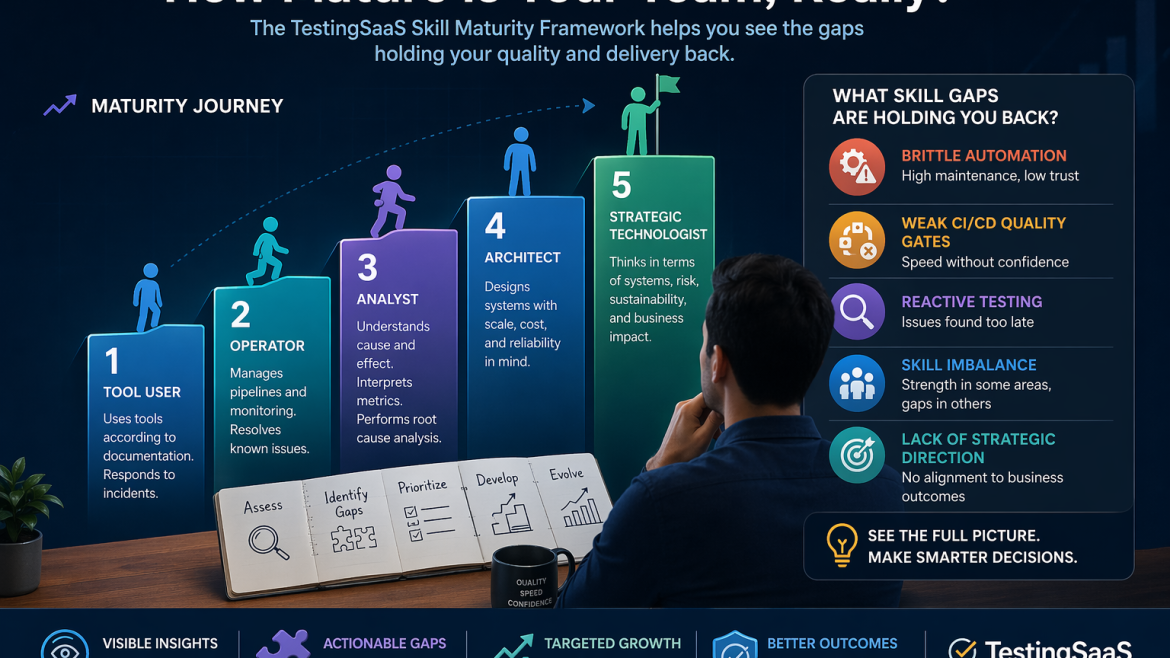
  • Level 1 – Tool User : Uses tools according to documentation. Responds to incidents.
  • Level 2 – Operator : Manages pipelines and monitoring. Resolves known issues.
  • Level 3 – Analyst : Understands cause and effect. Can interpret metrics.Performs root cause analyses.
  • Level 4 – Architect : Designs systems with scale, cost, and reliability in mind.
  • Level 5 – Strategic Technologist : Thinks in terms of systems, risk, sustainability, and business impact.

This clarity creates a shared understanding of excellence.

2. It Enables Objective, Multi-Dimensional Assessment

The framework allows teams to assess maturity across multiple dimensions, not just roles.

A single team might be:

  • Strong in automation execution
  • Weak in test architecture
  • Missing strategic quality leadership

By breaking skills into components, TestingSaaS highlights specific, actionable gaps.

3. It Exposes Hidden Imbalances

One of the most valuable insights the framework provides is imbalance.

For example:

  • Heavy investment in tools, but low skill maturity
  • Strong individual contributors, but no system-level thinking
  • Advanced CI/CD pipelines, but poor test design

These imbalances are often the root cause of:

  • Slow releases
  • Production defects
  • Scaling challenges

4. It Connects Skills Directly to Outcomes

This framework doesn’t just assess skills. It links them to real business impact.

Skill GapImpact
Low automation maturityHigh manual effort, slow feedback
Weak exploratory testingMissed edge cases, production issues
Lack of strategy-level skillsMisaligned quality direction
Poor CI/CD integrationDelayed releases

This makes it easier to justify where to invest and why.

From Insight to Action

The real strength of the TestingSaaS framework is not just diagnosis, it’s direction.

Targeted Upskilling

Teams can:

  • Focus on specific maturity gaps
  • Build structured learning paths
  • Track progress over time

Smarter Hiring

Instead of vague requirements:

“We need a senior tester”

You define:

“We need Level 3+ capability in automation architecture and CI/CD integration”

Continuous Improvement

The framework supports an ongoing cycle:

  1. Assess current maturity
  2. Identify gaps
  3. Prioritize high-impact areas
  4. Develop capabilities
  5. Reassess and evolve

This turns skill development into a repeatable system.

Final Thoughts

Skill gaps are inevitable. Hidden skill gaps are dangerous.

The TestingSaaS Skill Maturity Framework gives organizations the clarity to:

  • See where they truly stand
  • Understand what’s missing
  • Take targeted, effective action

Because in a world where speed and quality define success:

Maturity isn’t optional, it’s a competitive advantage.

worrying about IT skill growth

5 Mistakes That Block your Learning using a Skill Maturity Framework

5 Mistakes That Block your Learning using a Skill Maturity Framework 706 1127 Cordny

Skill maturity frameworks, like the TestingSaaS Skill Maturity Framework are everywhere in IT, but most fail at their core purpose: helping people actually improve. Instead, they often become labeling systems that create the illusion of progress without real capability growth.

If you’ve built or are using a Maturity framework like the TestingSaaS Skill Maturity framework, here are five critical mistakes that can quietly block learning upgrades.


The 5 critical mistakes when using a Skill Maturity Framework

1. Treating maturity like a checklist


One of the most common pitfalls is reducing maturity levels to a set of completed tasks: tools used, practices adopted, or boxes ticked. But real maturity isn’t about what you use, it’s about how you think. When people equate “I use automation” with “I’m advanced,” they skip the deeper layer: understanding trade-offs, risk, and impact. A strong framework defines levels through decision-making quality, not activity.

2. Overvaluing tools and automation


Automation is often mistaken as the ultimate sign of maturity. In reality, it’s just an amplifier. Without strong foundations in for instance test design, exploratory testing, and risk analysis, automation simply scales poor thinking. This is how teams end up with thousands of tests and still miss critical bugs. Maturity should prioritize thinking first and automation comes later to extend that capability.

3. Measuring activity instead of outcomes


Many frameworks track progress through metrics like number of test cases, coverage percentages, or automation counts. These are easy to measure but misleading. They say nothing about whether quality is improving. If maturity isn’t tied to outcomes like reduced escaped defects, faster feedback loops, or increased release confidence, learning of the system and skill development stalls. What matters is impact, not output.

4. Ignoring context


A one-size-fits-all maturity model doesn’t work. The expectations for a fintech platform handling sensitive transactions are very different from those of a fast-moving startup. When frameworks ignore context, teams either over-engineer (slowing themselves down) or under-invest (increasing risk). True maturity is contextual, it adapts to risk, scale, and business needs.

5. Missing the upgrade path


Many frameworks describe levels clearly but fail to explain how to move between them. This leaves people stuck. Knowing your level is useless if you don’t know what to do next. Effective models define the transition: what to stop doing, what to start doing, and what signals indicate progress. Growth requires direction, not just classification.

The real problem: maturity as status


The biggest mistake is cultural. When maturity becomes a label, something to defend or compare, it stops being a learning tool. People optimize for looking advanced instead of becoming better.

An IT Skill maturity framework should act as a thinking model, not a scoring system. Its purpose is to evolve how teams make decisions, prioritize risks, and deliver value with a diverse level of IT professionals.

If your framework is working, you’ll see it in subtle but powerful ways: teams ask better questions, simplify their strategies, and catch meaningful issues earlier. That’s real maturity and that’s what drives lasting improvement.

Need help refining your IT Skill Maturity model? Let’s break it down together.

a picture of a strategic IT Technologist

What do Strategic Technologists? Aligning Engineering & Business

What do Strategic Technologists? Aligning Engineering & Business 1536 1024 Cordny

Most engineering teams are very good at building systems.

They:

  • ship features.
  • improve performance.
  • maintain reliability.

But many still struggle with one critical question:

How does this create real business impact?

This is where the role of the Strategic Technologist begins.

Beyond Architecture: The Final Shift

In the TestingSaaS Skill Maturity Framework, becoming a Strategic Technologist is the final stage:

Level 5 — Strategic Impact

It’s the transition from:

  • Designing systems
  • Understanding trade-offs

To:

  • Aligning engineering decisions with business outcomes
  • Optimizing systems at an organizational level

Most engineers never fully make this shift.

Not because they lack technical skill.
But because they were never trained to think in business terms.

What Is a Strategic Technologist?

A Strategic Technologist connects two worlds:

  • Engineering systems
  • \Business strategy

They don’t just ask:

“Can we build this?”

They ask:

“Should we build this, and what impact will it have?”

Core characteristics

A Strategic Technologist:

  • Thinks in business value, not just technical output
  • Understands cost, risk, and ROI
  • Uses technology to drive decisions, not just implement them
  • Aligns engineering with long-term strategy
  • Balances performance, sustainability, and scalability

The Hidden Gap in Most Teams

Most teams operate in:

  • Tool usage
  • Implementation
  • System design

But very few operate in:

  • Strategic alignment

This creates a gap:

Engineering FocusBusiness Reality
Optimize latencyImprove customer retention
Reduce errorsProtect revenue streams
Scale systemsControl operational costs

Without alignment, even great engineering:

  • Doesn’t translate into business value
  • Becomes cost instead of investment
  • Loses influence at leadership level

Where This Fits in the TestingSaaS Framework

The TestingSaaS Skill Maturity Framework defines this progression:

Level 1 – Tool User
Uses tools according to documentation.
Responds to incidents.

Level 2 – Operator
Manages pipelines and monitoring.
Resolves known issues.

Level 3 – Analyst
Understands cause and effect.
Can interpret metrics.
Performs root cause analyses.

Level 4 – Architect
Designs systems with scale, cost, and reliability in mind.

Level 5 – Strategic Technologist
Thinks in terms of systems, risk, sustainability, and business impact.

This final level is where engineering becomes decision-making power.

What Alignment Actually Looks Like

Let’s make this practical.

Example 1 — Performance Engineering

Architect mindset:

  • Improve latency
  • Optimize queries

Strategic Technologist mindset:

  • Does performance impact conversion rates?
  • What is the revenue impact of 1 second delay?
  • Where should we invest for maximum ROI?

Example 2 — Observability

Architect mindset:

  • Design dashboards
  • Monitor systems

Strategic Technologist mindset:

  • Which signals influence business decisions?
  • Are we measuring user experience or internal noise?
  • Can observability reduce business risk?

Example 3 — Green IT

Architect mindset:

  • Optimize infrastructure
  • Reduce compute usage

Strategic Technologist mindset:

  • How does sustainability affect brand and compliance?
  • Can Green IT reduce cost and improve positioning?
  • What KPIs matter at board level?

The Language Shift

To align engineering and business, you must change your language.

From:

  • CPU usage
  • latency
  • error rates

To:

  • cost per transaction
  • user experience impact
  • revenue risk
  • sustainability metrics

Same systems. Different conversation.

Why This Is So Hard

Because most engineers are trained to:

  • build
  • optimize
  • fix

Not to:

  • justify
  • prioritize
  • influence

And most organizations:

  • separate engineering and business
  • measure output, not impact

How to Develop Strategic Thinking

1. Understand the business model

Ask:

  • How does this company make money?
  • What are the biggest risks?
  • Where are margins under pressure?

2. Translate metrics into impact

Example:

  • “Latency improved by 200ms”
  • “Conversion increased by 3%”

3. Prioritize based on value

Not all improvements matter equally.

Focus on:

  • high-impact areas
  • measurable outcomes
  • strategic goals

4. Use observability as a business tool

Observability is not just technical insight.

It can answer:

  • Where are users dropping off?
  • Which features create value?
  • Where is cost increasing?

5. Think in systems AND organizations

A Strategic Technologist understands:

  • systems architecture
  • team structure
  • business constraints

🌱 The Role of Observability & Green IT

Within TestingSaaS, two domains strongly support this shift:

Observability

  • Connects system behavior to user impact
  • Enables data-driven decisions

Green IT

  • Connects engineering to sustainability goals
  • Links cost, efficiency, and compliance

👉 Both are bridges between engineering and business.

Final Thought

The highest level of engineering is not technical mastery.

It’s strategic influence.

When you become a Strategic Technologist:

  • You don’t just build systems
  • You shape decisions
  • You drive impact

And that’s where engineering becomes a business asset, not just a cost center.

👉 Want to understand where you are on this journey?
Explore the TestingSaaS Skill Maturity Framework on testingsaas.nl.

💬 Question:
What engineering decision recently had the biggest business impact in your organization?