Most engineering teams are very good at building systems.
They:
- ship features.
- improve performance.
- maintain reliability.
But many still struggle with one critical question:
How does this create real business impact?
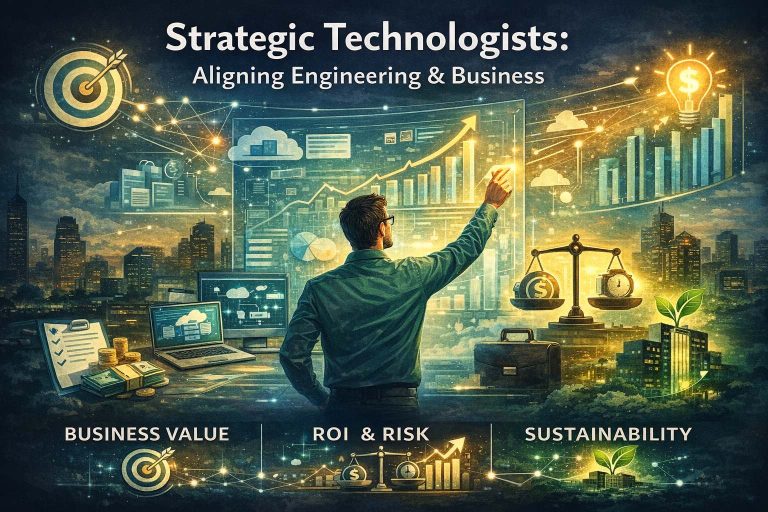
This is where the role of the Strategic Technologist begins.
Beyond Architecture: The Final Shift
In the TestingSaaS Skill Maturity Framework, becoming a Strategic Technologist is the final stage:
Level 5 — Strategic Impact
It’s the transition from:
- Designing systems
- Understanding trade-offs
To:
- Aligning engineering decisions with business outcomes
- Optimizing systems at an organizational level
Most engineers never fully make this shift.
Not because they lack technical skill.
But because they were never trained to think in business terms.
What Is a Strategic Technologist?
A Strategic Technologist connects two worlds:
- Engineering systems
- \Business strategy
They don’t just ask:
“Can we build this?”
They ask:
“Should we build this, and what impact will it have?”
Core characteristics
A Strategic Technologist:
- Thinks in business value, not just technical output
- Understands cost, risk, and ROI
- Uses technology to drive decisions, not just implement them
- Aligns engineering with long-term strategy
- Balances performance, sustainability, and scalability
The Hidden Gap in Most Teams
Most teams operate in:
- Tool usage
- Implementation
- System design
But very few operate in:
- Strategic alignment
This creates a gap:
| Engineering Focus | Business Reality |
| Optimize latency | Improve customer retention |
| Reduce errors | Protect revenue streams |
| Scale systems | Control operational costs |
Without alignment, even great engineering:
- Doesn’t translate into business value
- Becomes cost instead of investment
- Loses influence at leadership level
Where This Fits in the TestingSaaS Framework
The TestingSaaS Skill Maturity Framework defines this progression:
Level 1 – Tool User
Uses tools according to documentation.
Responds to incidents.
Level 2 – Operator
Manages pipelines and monitoring.
Resolves known issues.
Level 3 – Analyst
Understands cause and effect.
Can interpret metrics.
Performs root cause analyses.
Level 4 – Architect
Designs systems with scale, cost, and reliability in mind.
Level 5 – Strategic Technologist
Thinks in terms of systems, risk, sustainability, and business impact.
This final level is where engineering becomes decision-making power.
What Alignment Actually Looks Like
Let’s make this practical.
Example 1 — Performance Engineering
Architect mindset:
- Improve latency
- Optimize queries
Strategic Technologist mindset:
- Does performance impact conversion rates?
- What is the revenue impact of 1 second delay?
- Where should we invest for maximum ROI?
Example 2 — Observability
Architect mindset:
- Design dashboards
- Monitor systems
Strategic Technologist mindset:
- Which signals influence business decisions?
- Are we measuring user experience or internal noise?
- Can observability reduce business risk?
Example 3 — Green IT
Architect mindset:
- Optimize infrastructure
- Reduce compute usage
Strategic Technologist mindset:
- How does sustainability affect brand and compliance?
- Can Green IT reduce cost and improve positioning?
- What KPIs matter at board level?
The Language Shift
To align engineering and business, you must change your language.
From:
- CPU usage
- latency
- error rates
To:
- cost per transaction
- user experience impact
- revenue risk
- sustainability metrics
Same systems. Different conversation.
Why This Is So Hard
Because most engineers are trained to:
- build
- optimize
- fix
Not to:
- justify
- prioritize
- influence
And most organizations:
- separate engineering and business
- measure output, not impact
How to Develop Strategic Thinking
1. Understand the business model
Ask:
- How does this company make money?
- What are the biggest risks?
- Where are margins under pressure?
2. Translate metrics into impact
Example:
- “Latency improved by 200ms”
- “Conversion increased by 3%”
3. Prioritize based on value
Not all improvements matter equally.
Focus on:
- high-impact areas
- measurable outcomes
- strategic goals
4. Use observability as a business tool
Observability is not just technical insight.
It can answer:
- Where are users dropping off?
- Which features create value?
- Where is cost increasing?
5. Think in systems AND organizations
A Strategic Technologist understands:
- systems architecture
- team structure
- business constraints
🌱 The Role of Observability & Green IT
Within TestingSaaS, two domains strongly support this shift:
Observability
- Connects system behavior to user impact
- Enables data-driven decisions
Green IT
- Connects engineering to sustainability goals
- Links cost, efficiency, and compliance
👉 Both are bridges between engineering and business.
Final Thought
The highest level of engineering is not technical mastery.
It’s strategic influence.
When you become a Strategic Technologist:
- You don’t just build systems
- You shape decisions
- You drive impact
And that’s where engineering becomes a business asset, not just a cost center.
👉 Want to understand where you are on this journey?
Explore the TestingSaaS Skill Maturity Framework on testingsaas.nl.
💬 Question:
What engineering decision recently had the biggest business impact in your organization?